
Different types of braces and aligners in 2027: which is best for you?
Metal, ceramic, self-ligating, custom and lingual braces and clear aligners compared, with each one's FDA status and what changed in 2026.
By Dr. Shadi Haykani, DDSNovember 17, 20266 min read
Medically reviewed by Dr. Shadi Haykani, DDSLast reviewed November 17, 2026
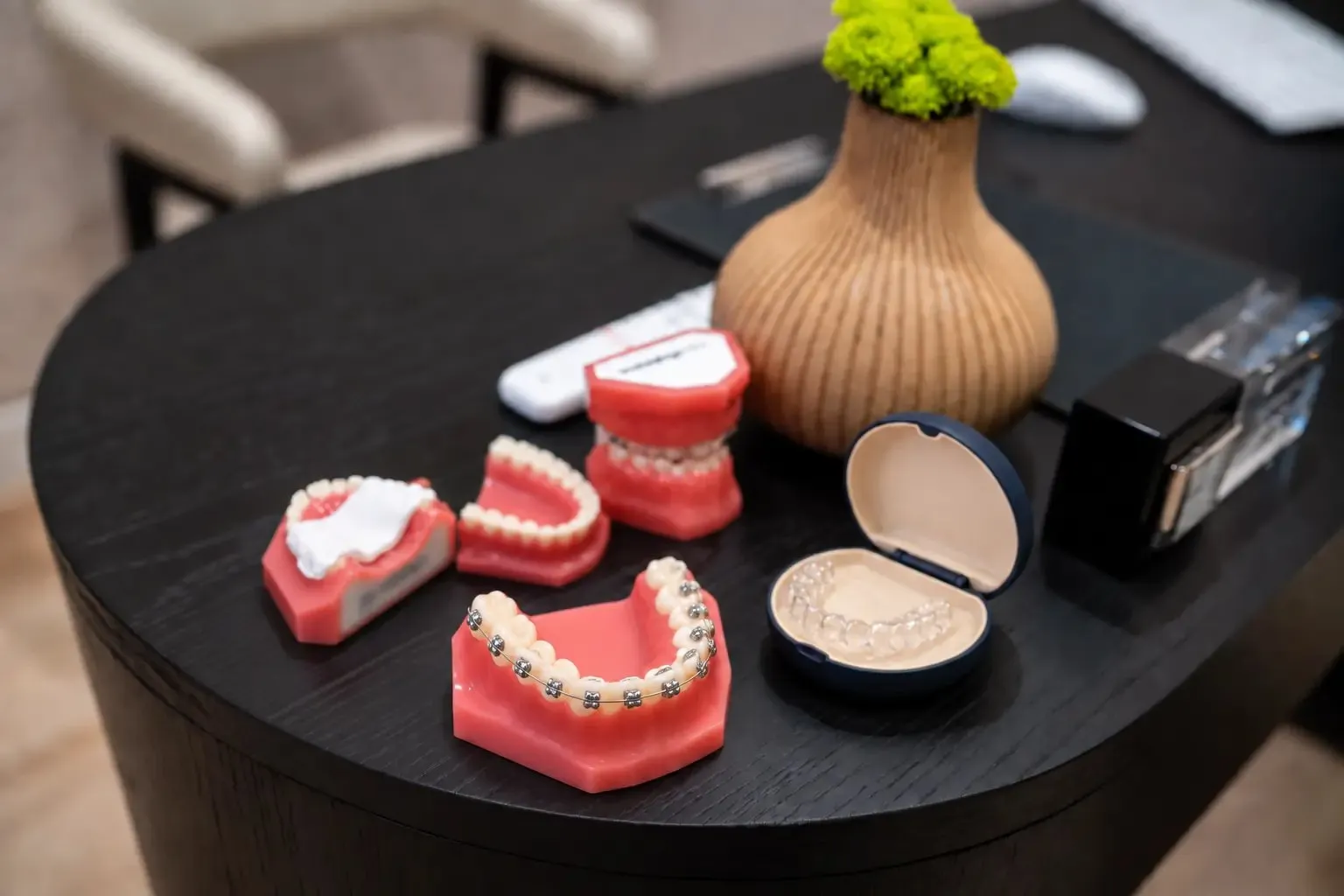
The main choices in 2027 are metal braces, ceramic braces, self-ligating braces such as Damon, custom brackets such as LightForce, lingual braces such as InBrace that sit behind the teeth, and clear aligners such as Invisalign and Spark. No type is best for everyone. The right one depends on the tooth movements and bite changes you need, how much the look of the appliance matters to you, and whether you can wear removable trays as directed. The FDA notes that there is really no faster method of straightening teeth.
This guide explains how each type works, what its FDA status means, and which orthodontic devices the FDA cleared in 2026. Use it to prepare questions for a consultation rather than as a ranking.
- The main options are metal, ceramic, self-ligating, custom and lingual braces, plus clear aligners, and all of them move teeth gradually.
- No type is fastest for everyone, and the FDA says there is really no faster method of straightening teeth.
- Metal brackets and expansion screws are Class I devices exempt from premarket notification, while ceramic brackets and aligners go through 510(k) clearance.
- By mid-November 2026 the FDA had cleared six new clear aligner products and six orthodontic software products, one adding AI to Invisalign planning.
What are the main types of braces and aligners?
Braces, clear aligners and other orthodontic devices are medical devices, so the FDA regulates them. The table shows where each type sits and how it reaches the market.
| Type | Where it sits | FDA route |
|---|---|---|
| Metal braces | Front of the teeth | Class I, exempt from premarket notification |
| Ceramic braces | Front of the teeth, tooth-colored | Class II, 510(k) clearance |
| Self-ligating braces such as Damon | Front of the teeth, with a built-in clip | Metal: Class I, exempt. Clear: 510(k) clearance |
| Custom brackets such as LightForce | Front of the teeth, made for one patient | Class II, 510(k) clearance |
| Lingual braces such as InBrace | Behind the teeth | InBrace: 510(k) clearance. Metal lingual brackets: Class I, exempt |
| Clear aligners such as Invisalign and Spark | Over the teeth, removable | Class II, 510(k) clearance |
The FDA’s device classification database lists metal orthodontic brackets as Class I and exempt, and lists sequential aligners and ceramic brackets as Class II. The FDA explains that moderate-risk Class II devices are usually marketed through 510(k) clearance, while most low-risk Class I devices are exempt from premarket notification.
How do metal braces work?
Traditional braces use small brackets bonded to the teeth and a wire held in place by small elastic ties. The FDA describes how the dentist or orthodontist adjusts the wire at regular visits, gradually shifting the teeth.
Because metal brackets are exempt Class I devices, the label FDA-cleared does not apply to them. Our metal braces page explains which crowding, spacing and bite concerns they are used for at our office.
What are ceramic and clear braces?
Brackets can be made of metal, plastic or ceramic, and some are made to match the color of your teeth. Ceramic and plastic brackets are Class II devices, so each product needs its own 510(k) clearance.
Tooth-colored brackets blend in with your teeth, but like any braces they need careful cleaning, because food gets stuck in braces easily. See our ceramic braces page and our guide to whether ceramic braces stain.
Do self-ligating braces like Damon work faster?
Self-ligating brackets hold the wire with a built-in clip instead of elastic ties; our Damon braces page shows how the Damon system does it. A 2013 review of clinical studies found no significant differences between self-ligating and conventional brackets in early pain, the number of visits or total treatment time.
A 2024 review of clinical trials found less plaque and less bleeding of the gums with self-ligating brackets, with no difference in pocket depth or gum inflammation scores. Under the Damon name, the clear Damon 4Clear bracket has a 510(k) clearance from 2008; metal self-ligating brackets fall under the exempt metal-bracket class. Our comparison of Damon and traditional braces covers the practical differences.
What are custom brackets like LightForce?
In LightForce’s 510(k) summary, the system consists of patient-specific ceramic brackets, placement guides and planning software; the orthodontist sets the prescription, and the company makes the brackets with additive manufacturing, also called 3D printing.
The system was first cleared in 2018 under its earlier name, Signature Orthodontic System, with later clearances including one in 2023. See our LightForce braces page.
How do lingual braces like InBrace differ?
Lingual braces place the brackets and wires on the back of the teeth, so the FDA describes them as virtually invisible to other people.
InBrace’s 510(k) from 2021 describes a treatment planning software and orthodontic appliance system that corrects malocclusions with appliances individualized for each patient. See our InBrace page.
Are clear aligners an alternative to braces?
Clear aligners are removable trays made in a series for your teeth. The FDA notes that you wear each one for one to two weeks, that total treatment can take six to 18 months, and that aligners may not work for everyone’s teeth.
A 2024 systematic review found no significant difference in treatment time between clear aligners and fixed braces for mild to moderate crowding, based on low-certainty evidence. Invisalign’s original system was cleared in 1998, and Spark was cleared in 2018 with an update in 2025. See our Invisalign and Spark pages, or our guide to choosing braces or Invisalign.
Which orthodontic devices did the FDA clear in 2026?
The FDA’s 510(k) database lists these orthodontic clearances for 2026 for clear aligners, orthodontic software and orthodontic implants, as of November 17, 2026. No ceramic or plastic bracket clearance appeared in that search; metal brackets are exempt, so they never appear in it.
| Date | Type | Device | Company |
|---|---|---|---|
| January 7, 2026 | Clear aligners | Clear Aligner (SCF-3348) | Beame Medical Technology (Shenzhen) Limited |
| January 7, 2026 | Orthodontic software | SmileInspector | Amv Consulting, LLC |
| February 3, 2026 | Clear aligners | ZSmile System | Dror Orthodesign, Ltd. |
| March 4, 2026 | Orthodontic software | SureSmile Software | Dentsply Sirona, Inc. |
| April 15, 2026 | Clear aligners | SureSmile Aligner (ASSY500020) | Dentsply Sirona, Inc. |
| May 8, 2026 | Clear aligners | Smylio Aligners | Smylio, Inc. |
| May 8, 2026 | Orthodontic software | LingOral Dental Design System | Hangzhou ChohoTech Co., Ltd. |
| May 19, 2026 | Orthodontic implant (TAD) | OrthoEasy Pal; OrthoEasy Pal Long Neck | Bernhard Förster GmbH (Bernhard Foerster Ltd.) |
| July 2, 2026 | Clear aligners | FACE4D Aligner | Avinent Implant System S.L.U. |
| September 25, 2026 | Orthodontic software | Invisalign System | Align Technology, Inc. |
| October 7, 2026 | Orthodontic software | Dr.AlignNavi | InnoDtech, Inc. |
| October 23, 2026 | Orthodontic software | LuxDesign | LuxCreo, Inc. |
| October 30, 2026 | Clear aligners | Shining3D Clear Aligner System | Hangzhou SHINING3D Dental Technology Co., Ltd. |
One of these is a change to the Invisalign System. In September 2026 the FDA cleared an update that adds an optional AI-enabled prediction service to its 3D treatment planning software. The 510(k) summary says the doctor still reviews and approves the treatment plan before the aligners are made.
A clearance means the FDA found a device substantially equivalent to one already legally marketed, as the FDA explains. It does not rank devices, and it does not mean a device suits every case.
Which appliances work alongside braces and aligners?
- Many palatal expanders use an orthodontic expansion screw, a Class I device exempt from premarket notification. See our expander page.
- Temporary anchorage devices, or TADs, are small orthodontic implants; the FDA classifies orthodontic implants as Class II, and one new TAD system was cleared in 2026. See our TADs page.
- Surgical orthodontics combines braces with jaw surgery when the position of the jaws needs to change. See our jaw surgery page.
- Retainers hold the result. A Cochrane review notes that without a retention phase, teeth tend to return toward their starting position. See our retainers page.
How do you choose the right type?
Treatment time depends on how much correction you need, and the FDA says an average treatment period is two years. Orthodontics works by applying slow pressure to the bone around a tooth, and the FDA warns that moving teeth too quickly can damage that bone.
Bring these questions to your consultation, and see our full list of orthodontic treatment options:
- Which tooth movements and bite changes does my case need?
- Which of these types can make those movements, and which cannot?
- How will appearance, comfort, cleaning and eating differ during treatment?
- Will I also need an expander, TADs, elastics or another appliance?
- What retainer plan follows, and for how long?
Frequently asked questions
What type of braces is best for adults?
No single type is best for adults, and adults can explore every type in this guide. The FDA notes that, according to the American Association of Orthodontists, 1 in 3 orthodontic patients today are adults. The choice depends on the movements your bite needs, how visible you want the appliance to be, and whether removable trays fit your routine.
What is the fastest way to straighten teeth?
No method is reliably faster for everyone. The FDA says there is really no faster method of straightening teeth, because teeth move as the bone around them responds to slow pressure. A 2024 systematic review found similar treatment times for aligners and fixed braces in mild to moderate crowding.
Which braces are the least noticeable?
Lingual braces sit behind the teeth, and the FDA describes them as virtually invisible to other people. Clear aligners are transparent trays, and ceramic or plastic brackets can be made to match the color of your teeth. Which of these suits you depends on the movements your bite needs.
Are self-ligating braces better than regular braces?
Not in treatment time. A 2013 review found no significant differences in early pain, number of visits or total treatment time. A 2024 review found less plaque and gum bleeding with self-ligating brackets. Your orthodontist can explain whether those differences matter for your plan.
What does FDA-cleared mean for braces and aligners?
It means the FDA reviewed a 510(k) submission and found the device substantially equivalent to a legally marketed device. The FDA explains that most moderate-risk Class II devices are marketed this way. Metal brackets are Class I and exempt from premarket notification, so they are neither cleared nor approved.
More notes