
How does Invisalign work? From the scan to the last aligner
What each aligner does, what happens in the bone as a tooth moves, what attachments and IPR are for, and what the research says about whether Invisalign works.
By Dr. Shadi Haykani, DDSNovember 19, 20265 min read
Medically reviewed by Dr. Shadi Haykani, DDSLast reviewed November 19, 2026
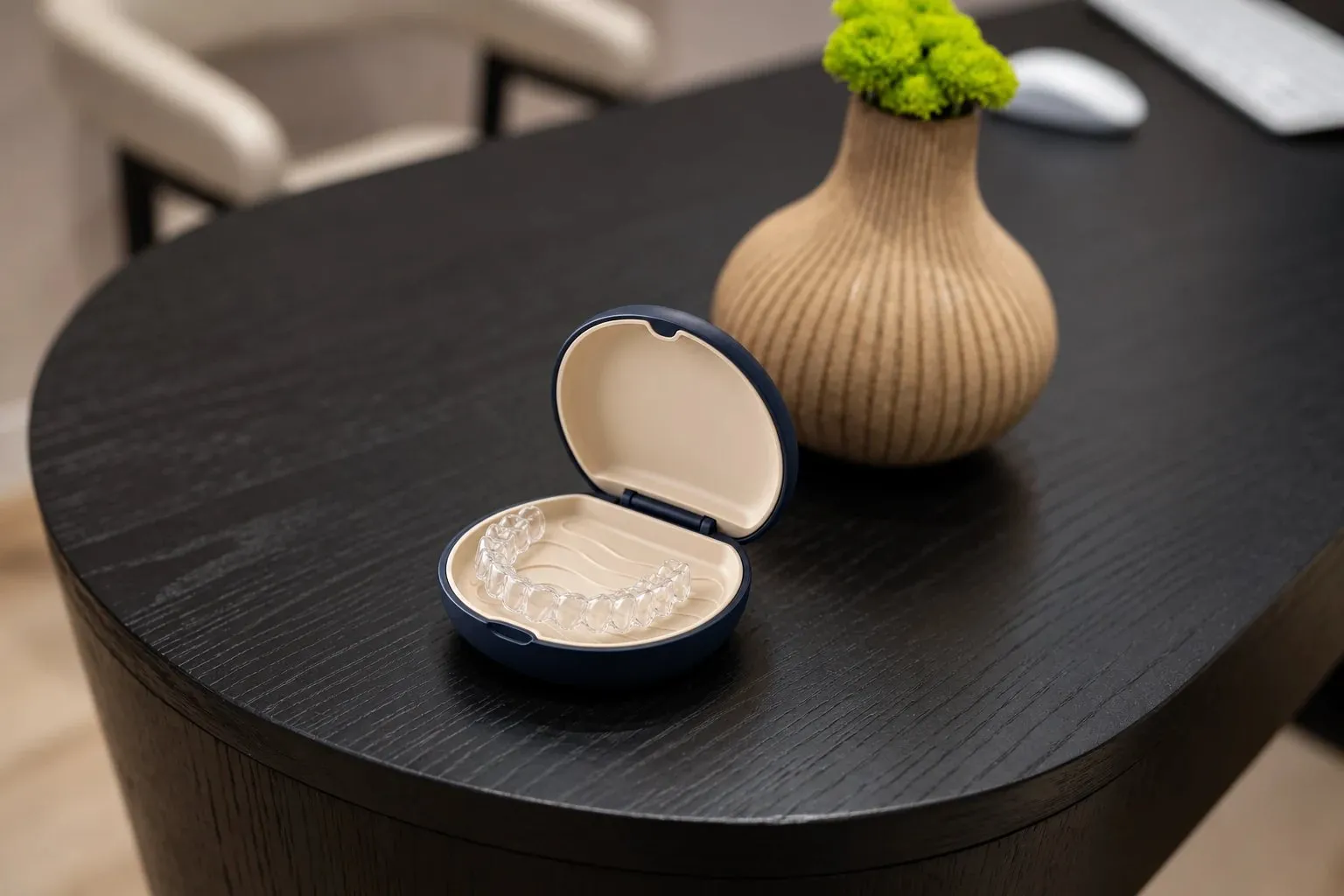
Invisalign moves teeth in small steps with a series of clear, custom-made aligners. A dentist or orthodontist plans the movement from a scan of your teeth, and each aligner is shaped a little differently from the one before. You wear each one for one to two weeks, and its steady pressure lets the bone around each tooth reshape so the tooth can move. Small tooth-colored bumps called attachments help the aligners move some teeth. The aligners only apply pressure while they are in your mouth, which is why daily wear time matters.
- Invisalign moves teeth in small steps with a series of custom clear aligners, each worn for one to two weeks.
- Each aligner’s steady pressure lets the bone around a tooth break down on one side and rebuild on the other.
- Attachments help aligners move some teeth, and IPR removes a thin layer of enamel between teeth to make room.
- In research the traditional wear protocol is 22 hours a day, and a trial found 12 hours corrected lower crowding less.
What happens to the bone when a tooth moves?
Each new aligner is made slightly out of line with your teeth as they are, so it presses on them where the plan needs them to move. The FDA explains that orthodontics works by applying slow pressure that affects the bone around a tooth to allow it to move.
A 2018 review of the biology describes what happens next. Tooth movement relies on the bone and the periodontal ligament, the fibers that hold each tooth in its socket, being broken down and rebuilt. Cells called osteoclasts remove bone on the side the tooth is pressed toward, and cells called osteoblasts lay down new bone on the side it moves away from.
The movement has to be gradual. The FDA warns that there is no faster method of straightening teeth: if movement is too rapid, tooth loss or a breakdown of the bone can occur.
What is the Invisalign process?
The steps are broadly the same wherever you have treatment:
- An exam and records. A licensed practitioner, such as a dentist or orthodontist, examines your teeth and advises which treatment you need. The assessment may include X-rays, photographs or scans of the teeth and jaws.
- A digital plan. The movements are staged from where your teeth are now to the planned finish, and a series of custom-made aligners is made from it.
- Attachments and the first aligners. If the plan uses attachments, small tooth-colored bumps are bonded to some teeth.
- A new aligner every one to two weeks, with check-ups to compare your progress with the plan.
- Refinements if they are needed, then a retainer, because without one teeth tend to return toward their starting position.
At our office the first step is a free consultation. Dr. Haykani reviews your examination, digital scan and appropriate X-rays, then explains whether Invisalign suits your case. Our Invisalign page walks through that plan.
Aligners are usually changed every one to two weeks, on the schedule your orthodontist gives you. The FDA says you wear each aligner for one to two weeks, and studies use 14 days per aligner as the conventional schedule.
Faster schedules are also in use. A 2024 systematic review compared changes every 7, 10 and 14 days and found no significant difference in tooth movement for most movements, with a few doing better on 14 days. The certainty of that evidence was very low.
Between changes, the aligners stay in most of the day and night. The FDA advises taking them out to eat and brushing and flossing afterward. Our Invisalign page asks for about 20 to 22 hours of wear a day, following Dr. Haykani’s instructions for your case.
Keep your teeth and the aligners clean while you wear them. The FDA cautions that not cleaning your teeth carefully can cause decay and swollen or bleeding gums, and our guide to cleaning Invisalign aligners covers the trays themselves.
What do attachments and IPR do?
Attachments are small tooth-colored bumps bonded to some teeth to help the aligners move them. A 2022 systematic review found that attachments mostly make aligner treatment more effective, helping with turning teeth, tilting the roots of the front teeth and moving teeth along the arch.
IPR, short for interproximal reduction, removes a thin layer of enamel from between some teeth. A 2014 review describes it as a way to gain a modest amount of space when teeth are crowded.
Our guides to Invisalign attachments and IPR explain each one in more detail, and our practice notes list every aligner guide.
Does Invisalign work?
For many people, yes, when the aligners suit the movements their teeth need and they are worn as prescribed. The FDA notes that clear aligners may not work for everyone’s teeth, so a dental exam comes first. As our Invisalign page explains, clear aligners may be an option for crowded teeth, spaces and several bite concerns, and the right choice depends on the movements your teeth need.
A 2023 review of the evidence notes that over the last ten years the Invisalign system has been refined to make results more predictable and to treat more complex bites, and that some tooth movements are still harder to achieve than others. A 2020 systematic review found that clear aligners may produce clinically acceptable results for the tilt of the upper and lower front teeth in mild to moderate cases, and that most movements may need more than one set of aligners to finish.
Wear time shows in the results. In a 2025 randomized trial, adults with mild crowding wore Invisalign either 22 hours a day, the traditional protocol, or 12 hours. Crowding of the lower teeth was corrected significantly less with 12 hours.
Many plans need fine-tuning near the end. In a 2022 survey of Australian orthodontists, they reported an average of about two refinements per patient: further sets of aligners for the movements that need more work. Our guides to Invisalign refinements and Invisalign not tracking explain both.
Frequently asked questions
What is Invisalign made of?
A clear, flexible thermoplastic. Studies of Invisalign aligners describe two materials used over the years: EX30, a PETG plastic, and SmartTrack, a polyurethane. A 2023 review notes that clear aligners in general are made from flexible materials such as polyurethane. Each aligner is custom-made for one stage of your plan.
Is Invisalign FDA-approved?
It is FDA-cleared, which is a different route. Invisalign’s original system was cleared through the FDA’s 510(k) process in 1998. The FDA explains that moderate-risk devices are usually marketed this way, once the maker shows the device is substantially equivalent to one already legally sold.
Can you make Invisalign work faster?
Not safely by changing aligners early. The FDA says there is no faster method of straightening teeth, because movement that is too rapid can damage the bone. Wear each aligner as prescribed and change it on the schedule your orthodontist sets.
Do other clear aligners work the same way?
Yes, in principle. The FDA classes them together as sequential aligners, and each brand provides a series of custom-made aligners worn for one to two weeks each. Brands differ in materials and software. Spark, the other aligner system we offer, works the same way.
More notes