
Can Invisalign fix an overbite? It depends on the cause
Which kind of overbite aligners correct, what the studies of deep bite found, how growth and the jaws change the plan, and what to ask at a consultation.
By Dr. Shadi Haykani, DDSNovember 19, 20265 min read
Medically reviewed by Dr. Shadi Haykani, DDSLast reviewed November 19, 2026
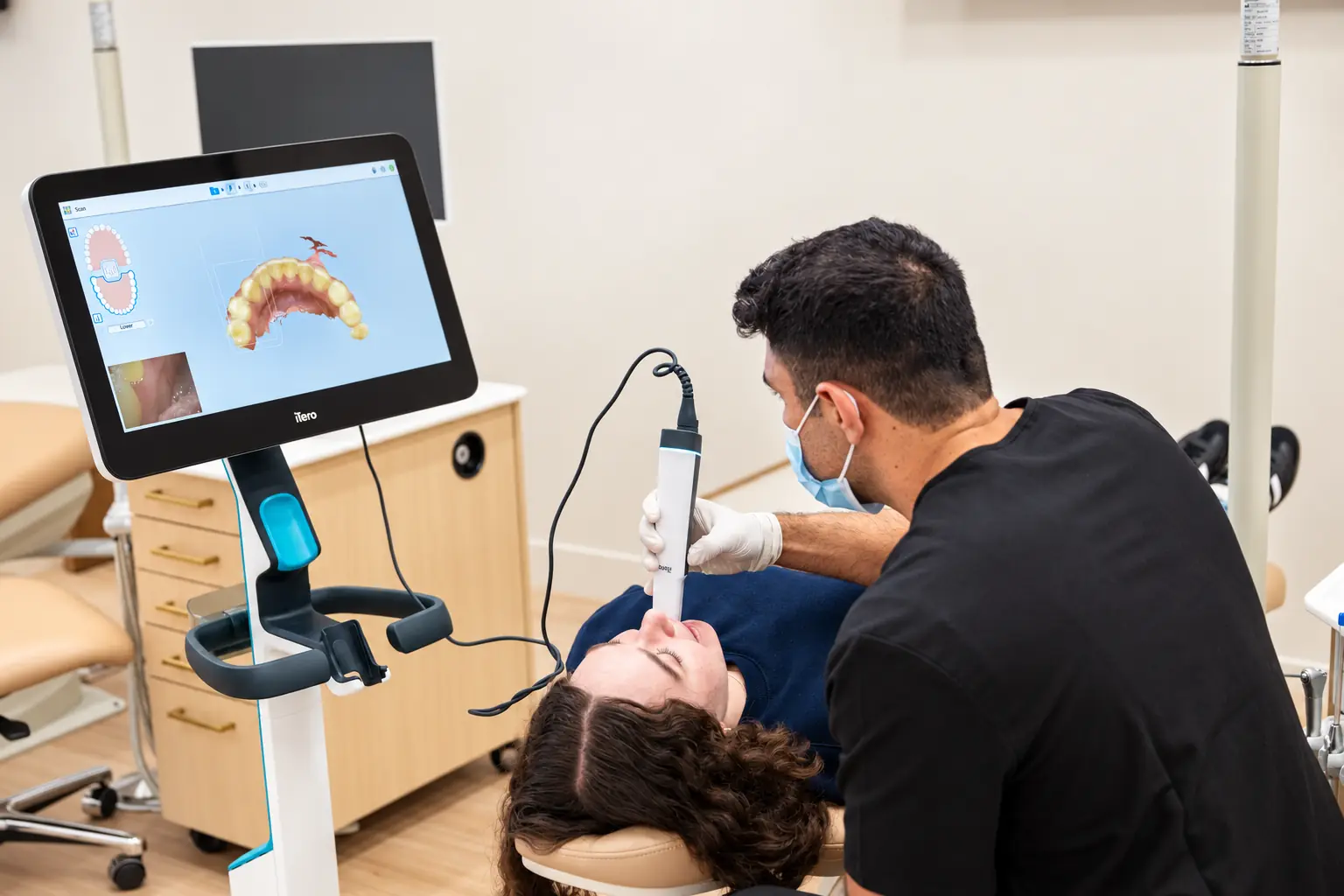
Invisalign can often fix an overbite when the overbite is mild to moderate and comes from the position of the teeth. Orthodontists call too much vertical overlap of the front teeth a deep bite, and a 2025 systematic review found that clear aligners can correct mild to moderate deep bites of that kind, while their results when the jaws are the cause remain uncertain. Upper front teeth that stick out are a different problem with its own answer. Dr. Haykani works out which kind you have before recommending aligners, braces or another approach.
- A 2025 review found clear aligners can correct a mild to moderate deep overbite that comes from the position of the teeth.
- When the jaws cause the overbite, the same review found the results of aligners compared with braces uncertain.
- Planned overbite correction with aligners often falls short, so plans often build in extra correction or add refinements.
- For upper teeth that stick out in a growing teen, studies of aligners that guide the lower jaw forward disagree.
Can Invisalign fix an overbite?
It depends on which overbite you mean. Our guide to overbite vs. underbite explains that in everyday speech an overbite can mean upper front teeth that cover too much of the lower ones, or upper front teeth that stick out too far. Orthodontists call the first a deep bite and measure the second as overjet, and aligners do not treat the two in the same way.
The practice’s answer on our Invisalign page is that Invisalign can correct some excessive overbites, where the upper front teeth overlap the lower teeth too much vertically, and that the cause and severity matter. Dr. Haykani assesses the teeth and the jaw relationship before explaining whether aligners, additional appliances or another approach would suit you.
Some overlap is normal. One study took 2 mm to 4 mm as the normal range for both the vertical overlap and the front-to-back gap, and a deep bite is common: a 2018 review of studies worldwide found a deep overbite in 21.98% of people. Our article on overbite vs. overjet explains the two measurements in more detail.
What do the studies show for a deep bite?
The 2025 review pulled together 18 studies of deep bites treated with clear aligners. Aligners opened the bite by 0.4 mm to 3.8 mm across the studies, and the correction actually achieved was 33% to 48.88% of the correction planned.
That gap between plan and result is the main point for patients. The review found that planned deep bite correction with aligners often falls short, which makes overcorrection or refinements necessary. It rated the evidence as low quality, and it found the results for skeletal cases, where the jaws cause the deep bite, uncertain compared with braces.
Orthodontists see the same difficulty. In a survey of Australian orthodontists, deep overbite was one of the two problems they felt least comfortable treating with aligners, along with a crossbite on both sides.
How does Invisalign fix an overbite?
One way is to move the front teeth up into the bone, a movement called intrusion. In a 2025 study of 24 people with deep bites treated with Invisalign, the overbite was reduced by 3.3 mm on average, and the upper and lower incisors moved 0.7 mm to 1.8 mm upward while the canines moved less.
Plans for deep bites often ask for more than is needed, because aligners tend to fall short. The patients in that study were treated with this built-in overcorrection, and the authors suggested that the starting overbite, the angles of the jaws and front teeth, and the use of Class II elastics, rubber bands that run between the upper and lower teeth, may affect how much is achieved. Our guide to rubber bands for braces explains what elastics do.
Small tooth-colored bumps called attachments help the trays grip the teeth. A review of the attachment studies found they seem to improve intrusion, though the evidence for that movement is still lacking. Our article on Invisalign attachments shows what they look like.
Can Invisalign fix upper teeth that stick out?
Often, when the teeth are the cause and the jaws are close to normal. One way aligners do it is to move the upper back teeth backward, a movement called distalization, which makes room to bring the front teeth back. A 2025 review of 16 studies of people with all their adult teeth, a Class II bite from the teeth and mild or no jaw difference found 1.84 mm to 2.98 mm of this movement after refinements.
The same review found that planning the movement in steps and adding refinements improved the results, and that starting Class II elastics early and checking how well the aligners are worn may make treatment more efficient. Wear matters here as it does everywhere with aligners: each tray works only while it is in.
For a deep bite in adults, aligners are not the only approach. A 2026 review of trials in adults found that tiny anchor screws may give a slight extra benefit when front teeth are moved up into the bone, though the size and consistency of that benefit were limited. Our page on temporary anchorage devices explains what those screws are.
What if the jaws cause the overbite?
Then growth and the size of the problem decide the plan. For teenagers who are still growing, some aligners include features meant to guide the lower jaw forward, the job a functional appliance does for upper teeth that stick out. One 2025 meta-analysis found these might be a viable option for mild to moderate cases, while a 2025 systematic review found the literature does not support them over traditional functional appliances. Both reviews ask for better studies.
For adults, the jaws no longer grow, so the choice is between moving the teeth within the jaws and correcting the jaws themselves. Our overbite guide notes that in severe cases, or when orthodontic treatment does not work, people may need jaw surgery as adults, and our page on surgical orthodontics explains how the two are combined.
Braces remain the other option. An overview of 18 systematic reviews found aligners effective for mild to moderate problems and weaker in severe cases and for some specific movements. Our comparison of Invisalign vs. braces covers the day-to-day differences.
What to ask at your consultation
- Is my overbite a deep bite, extra overjet or both?
- Do the teeth cause it, the jaws, or a mix of the two?
- How much correction does the plan build in, and how likely are refinements?
- Will I need elastics, and how many hours a day?
- If aligners are not the right fit, what would braces or a combined plan involve?
More notes on bites, aligners and braces are in our practice notes.
Frequently asked questions
How much can aligners open a deep bite?
In the 18 studies of a 2025 review, aligners opened deep bites by 0.4 mm to 3.8 mm, and the correction achieved was 33% to 48.88% of what was planned. A 2025 study of 24 people treated with built-in overcorrection found an average reduction of 3.3 mm. How much you need depends on your starting overbite.
Does fixing an overbite add time to Invisalign treatment?
It can. Planned deep bite correction with aligners often falls short, so many plans build in extra correction or need refinements, which means a new scan and more aligners. In a survey of Australian orthodontists, the average was about two refinements per patient. Dr. Haykani gives you a timeline once she has your scan and X-rays.
Can an overbite come back after Invisalign?
Teeth can drift after any orthodontic treatment. A Cochrane review of retention explains that without a phase of retention after treatment, teeth tend to relapse toward where they started, which is why retainers follow the last aligner. Ask how long to wear yours and what to do if it stops fitting.
Can an adult fix an overbite with Invisalign?
Often, when the teeth cause it. The 2025 study of deep bites treated with Invisalign included people aged 13 to 50, and the Class II review studied people with all their adult teeth. When the jaws cause a large overbite in an adult, aligners alone may not be enough, and a plan can combine orthodontics with jaw surgery. Dr. Haykani checks which applies.
More notes