
Open bite: what it is, the types and what causes it
How front and back open bites differ, the habits and jaw growth behind them, when a child's or an adult's bite should be checked, and how it is corrected.
SC OrthodonticsNovember 23, 20266 min read
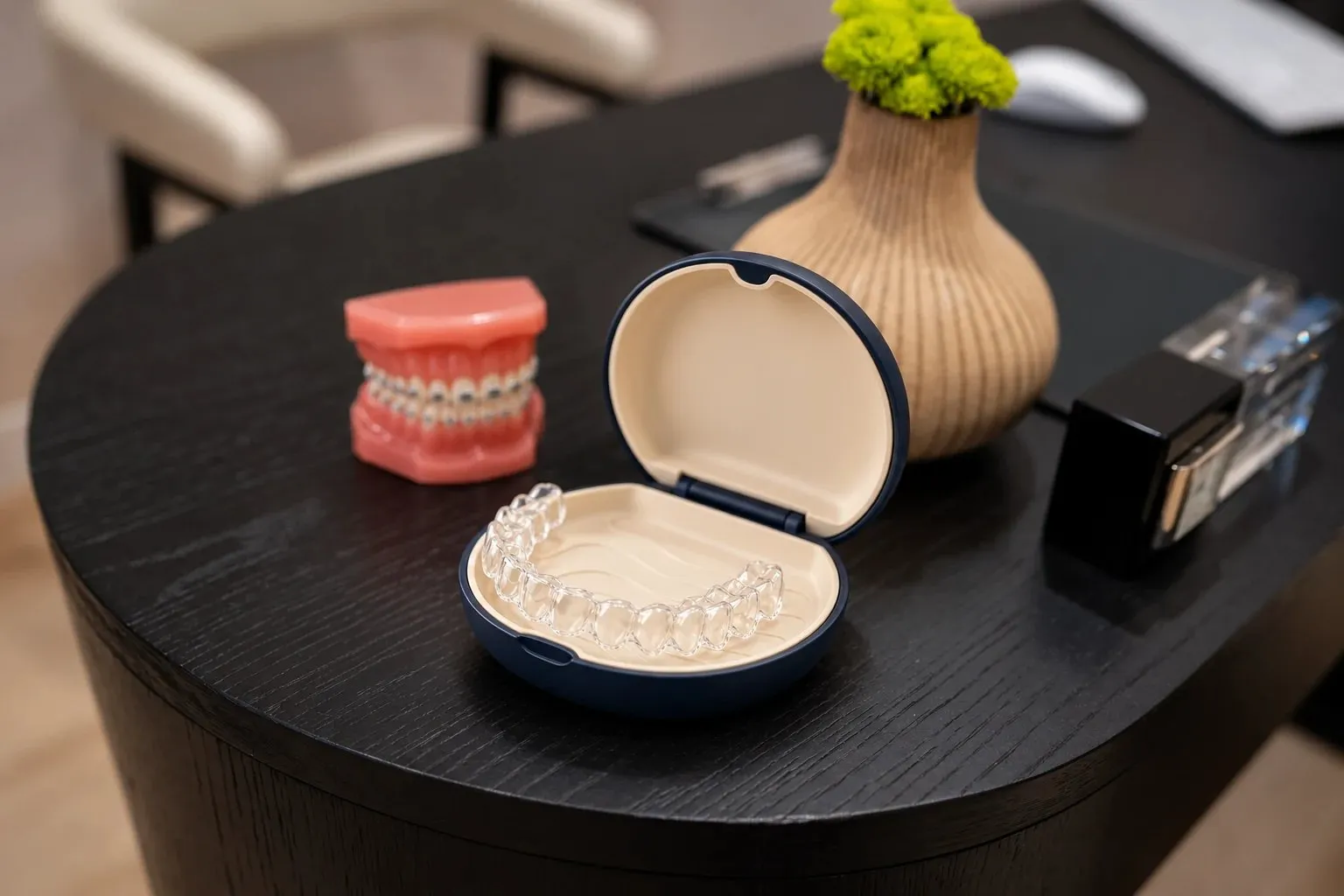
In an open bite, some upper and lower teeth do not touch when the jaws are closed. When the gap is between the front teeth while the back teeth meet, it is called an anterior open bite. A 2018 review of 53 studies found an open bite in 4.93% of people with all their adult teeth. Oral habits and unfavorable growth patterns are among the causes of an anterior open bite, and in children one linked to a sucking habit can close after the habit stops, though that evidence is of very low certainty. Orthodontic treatment with braces, clear aligners or other appliances is the main approach, and some cases need surgery to correct the jaws.
- An open bite means some upper and lower teeth stay apart when you close your jaws, at the front or at the back.
- A 2018 review of 53 studies found an open bite in 4.93% of people with all their adult teeth.
- Oral habits and unfavorable growth patterns are among the causes of an anterior open bite.
- In children, an open bite linked to a sucking habit can close after the habit stops, though that evidence is of very low certainty.
What is an open bite?
It is a gap between upper and lower teeth that should meet. The National Library of Medicine’s medical vocabulary defines an open bite as a condition in which certain opposing teeth fail to make contact when the jaws are closed, and it gives apertognathia as another name for it. An open bite is one kind of malocclusion, or abnormal bite.
Orthodontists count it among the vertical bite problems, along with a deep bite, where the front teeth overlap too much. A 2018 review of 53 studies from around the world found an open bite in 4.93% of people with all their adult teeth and a deep overbite in 21.98%. Our page on overbites covers deep bites.
What are anterior and posterior open bites?
Anterior open bite
In an anterior open bite, the upper and lower front teeth do not overlap or touch while the back teeth are together, so a gap shows at the front when you bite down.
Posterior open bite
Here the gap is between back teeth, while the teeth elsewhere meet. A 2020 review says a posterior open bite can impair chewing, and that it is poorly understood and not well studied.
Dental or skeletal open bite
Orthodontists also ask whether the teeth or the jaws cause the gap. A 2021 review of open bite management describes skeletal, dental and soft tissue effects that can combine to produce an anterior open bite. It notes that a skeletal open bite, one that comes from the jaws, needs a more complex approach to treatment.
What causes an open bite?
Usually several things together. A 2023 review describes the causes of an anterior open bite as a combination of genetic, environmental and developmental factors, and the Cochrane review names oral habits and unfavorable growth patterns among them.
- Thumb, finger and pacifier sucking are common in babies and young children and tend to stop as children get older, but a habit that continues while the adult teeth come in can contribute to an abnormal bite. Our guide to thumb sucking and teeth covers supportive ways to help a child stop.
- The tongue may play a part. A 2022 review of children and teens with bite problems found a relationship between an anterior open bite and an unusual swallowing pattern, while noting that the exact relationships remain unclear. Our article on tongue thrust explains what an assessment of the tongue looks at.
- A posterior open bite has its own causes. The 2020 review names primary failure of eruption, the tongue pushing out between the side teeth, some medical syndromes and problems in the jaw joints. Primary failure of eruption means teeth that fail to come in although nothing local or systemic is stopping them, most often the first and second molars.
When should an open bite be checked?
In childhood, as soon as it is noticed. The American Association of Orthodontists recommends an orthodontic evaluation when a problem is first noticed and no later than age 7.
Things worth mentioning at that visit include front teeth that stay apart when the back teeth meet, back teeth that do not touch, and trouble biting into food with the front teeth. An anterior open bite can lead to difficulties with speech, chewing and biting, the 2023 review notes, and a posterior open bite can make chewing harder.
How is an open bite corrected?
The cause and the age decide. Our guide to open bite treatment covers what an assessment checks, what a proposed plan should explain and why retention is discussed before treatment starts. Orthodontic treatment is the main approach, the 2023 review notes, and some cases need surgery to correct the jaws.
- A tongue crib, a small metal guard across the roof of the mouth, keeps a thumb or finger out of its sucking position, and cribs are also used when an open bite has been put down to the tongue. For children, a Cochrane review found weak evidence that a palatal crib worn with a chin cup, or a functional appliance used with lip-seal training, can correct an anterior open bite.
- Braces and clear aligners move the teeth into a better position. Our Invisalign page lists open bites among the bite concerns for which aligners may be an option.
- A temporary anchorage device, or TAD, is a small metal screw placed through the gum into bone. In selected cases TADs help move back teeth farther into their supporting bone to close an anterior open bite. A 2021 review found that this seems possible in adults and others who have stopped growing, though it could not say whether the results last as well as those of jaw surgery. Our TADs page explains when they are used.
- For a skeletal open bite after growth is complete, orthodontics can be combined with surgery that corrects the position of the jaws. Our page on surgical orthodontics explains how the orthodontist and the surgeon plan it together.
Results can slip back. A 2019 review of open bite in adults calls correction challenging because the causes are hard to pin down and the relapse rate is high.
Open bite in children and adults
For children, the main question is timing. Some children need early treatment for a developing problem, while for others treatment in adolescence, without an early phase, is recommended. Our article on Phase 1 and Phase 2 orthodontics explains the two approaches.
Adults have stopped growing, so treatment moves the teeth within the jaws or, for a skeletal open bite, combines orthodontics with surgery. The 2021 review of open bite management notes that treatment approaches differ for adults and growing patients, and the 2019 review adds that speech therapy may be part of the plan alongside orthodontics and surgery.
A bite that changes in adulthood is worth a check. In a report of 12 people with jaw joint disorders who came in with a posterior open bite, inflammation of the jaw joint was the cause in most, and conservative treatment, including medicines, resolved the open bite in almost all of them. Our guide to TMJ disorder covers the other symptoms of jaw joint problems.
After a blow to the face or jaw, teeth that no longer meet the way they did are among the signs doctors check for a broken jaw. Call 911 for breathing or swallowing difficulty, uncontrolled bleeding, or a serious facial or jaw injury.
Frequently asked questions
Is an open bite the opposite of an overbite?
In a way. Both are problems with the vertical overlap of the front teeth: in a deep overbite the upper front teeth cover too much of the lower ones, and in an anterior open bite they do not overlap at all. A 2018 review found a deep overbite in 21.98% of people with all their adult teeth and an open bite in 4.93%. In everyday speech, overbite can also mean upper front teeth that sit too far forward, which is a different measurement.
Will a toddler’s open bite correct itself?
It may, when a sucking habit is behind it. Thumb, finger and pacifier habits are common in young children and tend to stop as they get older, and a Cochrane review says a habit that continues while the adult teeth come in can contribute to an abnormal bite. A 2023 systematic review of children aged 4 to 12 found that an anterior open bite often corrected itself after a sucking habit stopped, with improvement of 50% to 100%, though the certainty of that evidence is very low. It did not study younger children, and it is not clear after what age stopping the habit no longer helps.
Can an open bite be fixed naturally?
For a child whose open bite comes from a sucking habit, stopping the habit may let it close, though that evidence is of very low certainty. None of the trials in a Cochrane review of children’s treatment tested exercises on their own: the one that used lip-seal training combined it with an appliance, and the review found weak evidence that the pair can correct an anterior open bite. Our article on mewing explains that mewing has not been shown to reshape the face or replace orthodontic treatment.
Can an open bite affect speech?
It can. A 2022 systematic review of children and teens found a relationship between an anterior open bite and distorted sounds made with the tip of the tongue against the ridge behind the upper front teeth. In a 2022 study of 39 people with a skeletal open bite, the s, t, k and ch sounds were more distorted than in a comparison group, and for t and k the distortion grew with the severity of the open bite. Treatment may include speech therapy as well as orthodontics.
More notes