
Impacted teeth: why a tooth gets stuck and how it is treated
Which teeth get impacted and why, the signs to look for, how an impacted tooth shows up on X-rays, and the treatments used at different ages.
SC OrthodonticsNovember 23, 20266 min read
An impacted tooth is a tooth that did not erupt (break through the gum) when it should have. Wisdom teeth are impacted most often, then canines, and premolars, front teeth and other molars can get stuck too. Something usually holds the tooth back: too little room, an extra tooth in its path, a baby tooth that has not fallen out or a path that sends it the wrong way. Some impacted teeth cause no trouble and are found only on an X-ray. Depending on the tooth and the person’s age, treatment means watching it, clearing its path, uncovering it so braces can guide it into place, or having it removed.
- An impacted tooth has not come through the gum when it should have, and wisdom teeth and canines are the ones most often affected.
- Too little room, an extra tooth, a baby tooth that stays and a tooth fused to the bone can all hold a tooth back.
- Treatment ranges from watching the tooth to clearing its path, uncovering it so braces can guide it, or removing it.
- Severe pain with facial swelling or fever needs urgent assessment; when the office is closed, go to urgent care or an emergency room.
What is an impacted tooth?
It is a tooth that has missed its time to come in. A 2026 review of 31 studies on canines describes tooth impaction as a failure of eruption within the expected timeframe, so the word fits a tooth that is late, whatever is holding it back.
An impacted tooth can sit completely under the gum, which is why a buried canine has to be surgically uncovered before it can be moved. Others come partway through: wisdom teeth can be blocked by another tooth or partly covered by the gums.
Impacted teeth are common. In a 2026 study of 7,903 panoramic X-rays of 13- to 20-year-olds in Peru, impacted teeth were found in 58.7%.
Which teeth are most often impacted?
Wisdom teeth, by a wide margin. In the Peru study, third molars (wisdom teeth) were impacted most often, followed by canines and then incisors, the flat front teeth.
Leaving wisdom teeth out, a study of 1,527 orthodontic patients aged 13 and older found an impacted tooth in 9.10%. These are the teeth it found impacted, from most to least often:
| Impacted tooth | Share of patients |
|---|---|
| Upper canine | 5.24% |
| Lower second premolar | 2.23% |
| Upper second premolar | 1.11% |
| Lower canine | 0.92% |
| Molar other than a wisdom tooth | 0.72% |
| Front tooth (incisor) | 0.65% |
The two teeth that get stuck most often have their own guides. Our article on impacted wisdom teeth covers the back teeth, and our guide to impacted canine teeth covers the pointed teeth at the corners of the smile.
Why do teeth get impacted?
Usually something blocks the tooth or steers it off course. For canines, the 2026 review lists the main causes as baby canines that stay in place, a narrow dental arch, extra teeth, odontomas (small growths of tooth tissue) and neighboring lateral incisors that never formed.
- Too little room. Wisdom teeth develop later than other teeth and may not have enough space to come through fully, and a 1996 review traced canines stuck on the lip side to a lack of space in the arch.
- An extra tooth in the way. A supernumerary (extra) tooth can stop a permanent tooth from coming in, and unerupted upper front teeth can be the result. Our guide to supernumerary teeth explains how extra teeth are found.
- A tooth fused to the bone. Ankylosis, where the root fuses with the bone around it, is one of the tooth eruption disorders a 2022 review describes, and our article on an ankylosed tooth explains what it means for a child’s teeth.
- A rare failure of eruption. In primary failure of eruption, teeth do not come in fully even though their path is clear. A 2018 review of 314 reported patients found the molars affected in every one of them.
What are the symptoms of an impacted tooth?
Often there is nothing to feel. The clues are things a parent or a dentist can see:
- An adult tooth that has come in on one side of the mouth but not on the other. A 1996 review lists a pronounced difference between the left and right canines among the reasons to suspect an impacted canine.
- A gap where a tooth should be. Canines displaced into the roof of the mouth can leave gaps and damage the roots of the teeth around them.
- At the back of the mouth, a wisdom tooth only partly through the gum. One that cannot come through fully can cause pain and swelling, a gum infection or food getting stuck.
See your dentist or oral surgeon if the gum around a partly erupted tooth is sore or swollen. Severe pain with swelling of the face, jaw or floor of the mouth, or with fever, needs urgent assessment; when the office is closed, go to urgent care or an emergency room. Call 911 if breathing or swallowing is affected.
How is an impacted tooth found?
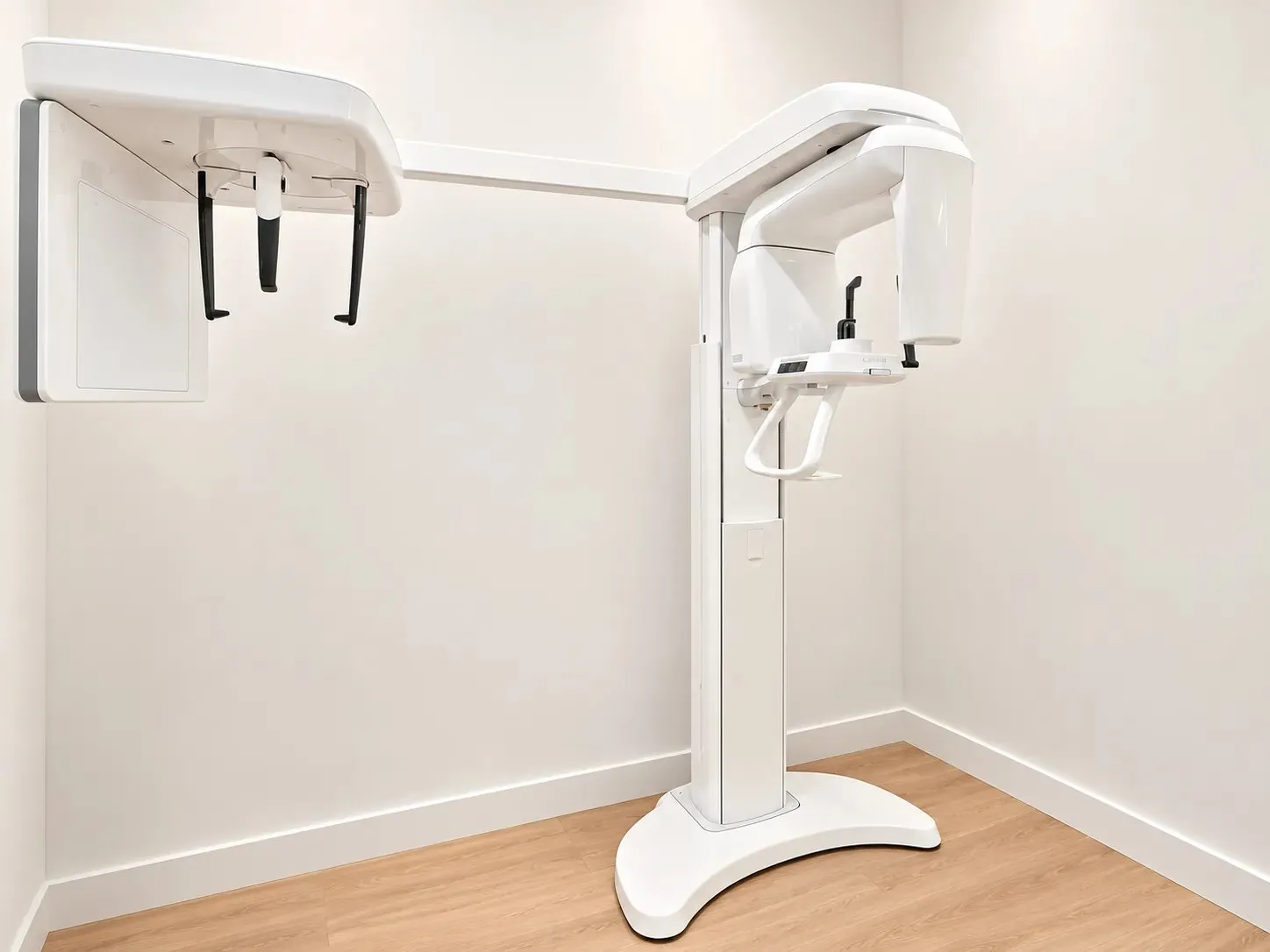
With an exam and X-rays. Your dentist looks at your teeth, and you may need dental X-rays, and a panoramic X-ray, which shows all the teeth and both jaws in one picture, can show teeth still hidden under the gum. Our guide to orthodontic X-rays explains what each kind of image shows.
A 3D image helps when the exact position matters. The 2026 canine review found cone-beam CT, a 3D X-ray, more accurate than a panoramic X-ray in diagnosing impacted canines.
The authors of the Peru study recommend periodic X-ray checks during adolescence for early detection.
How are impacted teeth treated?
The plan depends on which tooth is stuck, where it sits and how old you are. These are the usual options:
- Watching it. A wisdom tooth that is not causing problems is usually left where it is and checked at routine dental visits.
- Clearing its path. Removing an extra tooth or making room in the arch can give a tooth the chance to come in. For a canine heading into the roof of the mouth, removing the baby canine is an early step used to help the adult canine come in.
- Uncovering it and guiding it with braces. An oral surgeon exposes the tooth, and the orthodontist then moves it into line with braces. Cochrane reviewers describe the treatment of canines in the roof of the mouth as surgical exposure followed by fixed braces, and our page on metal braces explains how braces move teeth.
- Removing it. MedlinePlus lists extractions (pulling teeth) for impacted teeth that are causing problems. Your dentist or an oral surgeon takes the tooth out, and our article on tooth extraction for braces covers how a removal fits into an orthodontic plan.
Braces cannot move every stuck tooth. In primary failure of eruption, pulling the teeth with braces makes them fuse to the bone, and the 2018 review recommends a genetic test before orthodontic treatment when the condition is suspected. An ankylosed tooth does not respond to braces in the usual way either.
Extractions are done by your dentist or an oral surgeon, and exposure surgery by an oral surgeon. Our office coordinates the orthodontic part of the plan with your dentist or oral surgeon.
Impacted teeth in children, teens and adults
In children, the aim is to notice a tooth going off course early. The American Association of Orthodontists recommends an orthodontic evaluation by age 7 or when a problem is first noticed, whichever comes first. A 2025 guideline asks dentists to check how the adult canines are coming in between the ages of 10 and 13 and to refer those that are out of position. Our guide to a child’s first orthodontic visit explains what that check covers.
In the teens, attention turns to the wisdom teeth, which usually start coming through in the teens or early 20s.
Adults can still have an impacted canine brought into place, with lower odds. In a 2003 study of 19 adults, 69.5% of their impacted upper canines were brought into line, compared with all of them in matched teenagers. Every canine that failed belonged to a patient over 30, and resolving the impaction took the adults longer.
Frequently asked questions
Is an unerupted tooth the same as an impacted tooth?
Not always. An unerupted tooth is any tooth that has not come through the gum yet, which is normal for a tooth whose time has not come. A tooth is called impacted once it has missed that time: a 2026 review describes impaction as a failure of eruption within the expected timeframe. A dentist tells the two apart by the person’s age, by comparing the same tooth on the other side and by an X-ray that shows where the tooth sits.
What does an impacted tooth look like?
Often you cannot see it, because it is still under the gum. What shows is the space it should fill: a baby tooth still in place, a gap, or a neighboring tooth tipped out of line. A 1996 review lists a lateral incisor that is tipped among the signs of an impacted canine. At the back of the mouth, an impacted wisdom tooth may show only partly, with gum over the rest of it. An X-ray shows the tooth itself.
Can braces fix impacted teeth?
Often they can, with a surgeon’s help. Braces open the space the tooth needs, and when the tooth is under the gum, an oral surgeon uncovers it and bonds a small attachment to it. The orthodontist then pulls the tooth gently into line, which is called orthodontic traction. For upper front teeth held back by an extra tooth, clinical recommendations advise checking for natural eruption after 2 to 3 months once the extra tooth is removed, and using orthodontic traction if the tooth does not come in. Our guide to impacted canine teeth explains exposure, bonding and traction step by step.
Can an impacted tooth cause pain?
It can. The NHS says a wisdom tooth that cannot come through fully can cause pain and swelling, gum infection or food getting stuck. A canine stuck in the roof of the mouth can damage the roots of nearby teeth, which is one reason it is checked even when nothing hurts. See your dentist or oral surgeon about a sore or swollen gum. Severe pain with facial swelling or fever needs urgent assessment; when the office is closed, go to urgent care or an emergency room.
Can a front tooth be impacted?
Yes, though less often than a wisdom tooth or a canine. In the study of 1,527 orthodontic patients, front teeth (incisors) were impacted in 0.65%. An extra tooth in its path is one cause, and clinical recommendations advise removing such an extra tooth early, ideally before age 7. If one upper front tooth has come in and the one beside it has not, ask your dentist to check.
More notes