
Snaggle tooth: what it is and how it is straightened
What people mean by a snaggle tooth, why a tooth comes in out of line, when a child's canine needs a check, and how braces or aligners move it into place.
By Dr. Shadi Haykani, DDSNovember 19, 20265 min read
Medically reviewed by Dr. Shadi Haykani, DDSLast reviewed November 19, 2026
A snaggle tooth is a tooth that grows in out of line with the teeth beside it: it sticks out, sits higher, overlaps or turns. It is an everyday name, not a clinical one, and it is often used for an upper canine, the pointed tooth below the eye, crowded out of line. Teeth that are out of line are common: in a US national survey, only 35% of adults had well-aligned lower front teeth. Braces or clear aligners can move a snaggle tooth into line, sometimes after space is made for it.
- A snaggle tooth is an everyday name for a tooth that grows in out of line, most often an upper canine.
- Crowding is the usual reason, and canines can also be held back by baby teeth that stay, extra teeth or a narrow arch.
- Braces or clear aligners move the tooth into line, sometimes after space is made by widening the arch or removing teeth.
- The American Association of Orthodontists recommends a first orthodontic check no later than age 7.
What is a snaggle tooth?
People use the name, also spelled snaggletooth, for any tooth that stands out from the line of the others. It may stick out toward the lip, sit higher than its neighbors, overlap the tooth next to it or be turned on its axis. Orthodontists describe the same tooth by its position: crowded, rotated or displaced.
The name is often used for an upper canine. Canines are the long, pointed teeth at the corners of the mouth. One that has no room can come in out of line, or stay under the gum, which orthodontists call an impacted canine.
Teeth out of line are common. The NHANES III survey of the US population found noticeable irregularity of the front teeth in the majority of every group it studied, and in 15% it was severe enough that arch expansion or removing some teeth would be needed to correct it.
What causes a snaggle tooth?
Most often, crowding: the teeth need more room than the jaw has, so one is pushed out of line. A review of orthodontic treatment names crowding, a poor bite and missing teeth as the causes of improper tooth alignment.
For canines there are a few more causes. A 2026 review of 31 studies on canines that do not come in listed baby canines that stay too long, a narrow dental arch, extra teeth, small growths called odontomas, and inherited patterns such as missing lateral incisors, the teeth next to the canines. The same review found the upper canines held back in 0.97% to 7.10% of people in the studies it pooled. After wisdom teeth, canines are the teeth most often held back from coming in.
Is a snaggle tooth a problem?
For many people it is mainly about how the smile looks, and that is a fair reason to ask about treatment. It can matter for more than looks. Teeth that are out of line can make eating and speech harder and wear down early.
Wanting it fixed is common too. The review of orthodontic treatment estimates that more than 20% of children would benefit from treatment for crowding, bite problems or missing teeth, and that many of these problems persist into adulthood if they are not corrected. Applying a treatment-need index to the national survey, the NHANES III authors found that 57% to 59% of each group studied had at least some need for orthodontic treatment.
A canine that stays under the gum is a different situation from one that came in crooked. The 2026 review stresses early diagnosis and the right imaging, because a canine that is held back can damage the roots of the teeth beside it. Our guide to impacted canine teeth explains how that is found and treated.
How does an orthodontist check a snaggle tooth?
With an exam and records. An orthodontic assessment may include examining the teeth and jaws and taking X-rays, photographs or scans of them, as the NHS braces guide describes.
Imaging matters most for a canine that has not come in. The 2026 review found that 3D cone-beam CT scans were more accurate than a standard panoramic X-ray for finding where such a canine sits, and it found the canine most often lying toward the roof of the mouth. Your orthodontist decides which imaging you need.
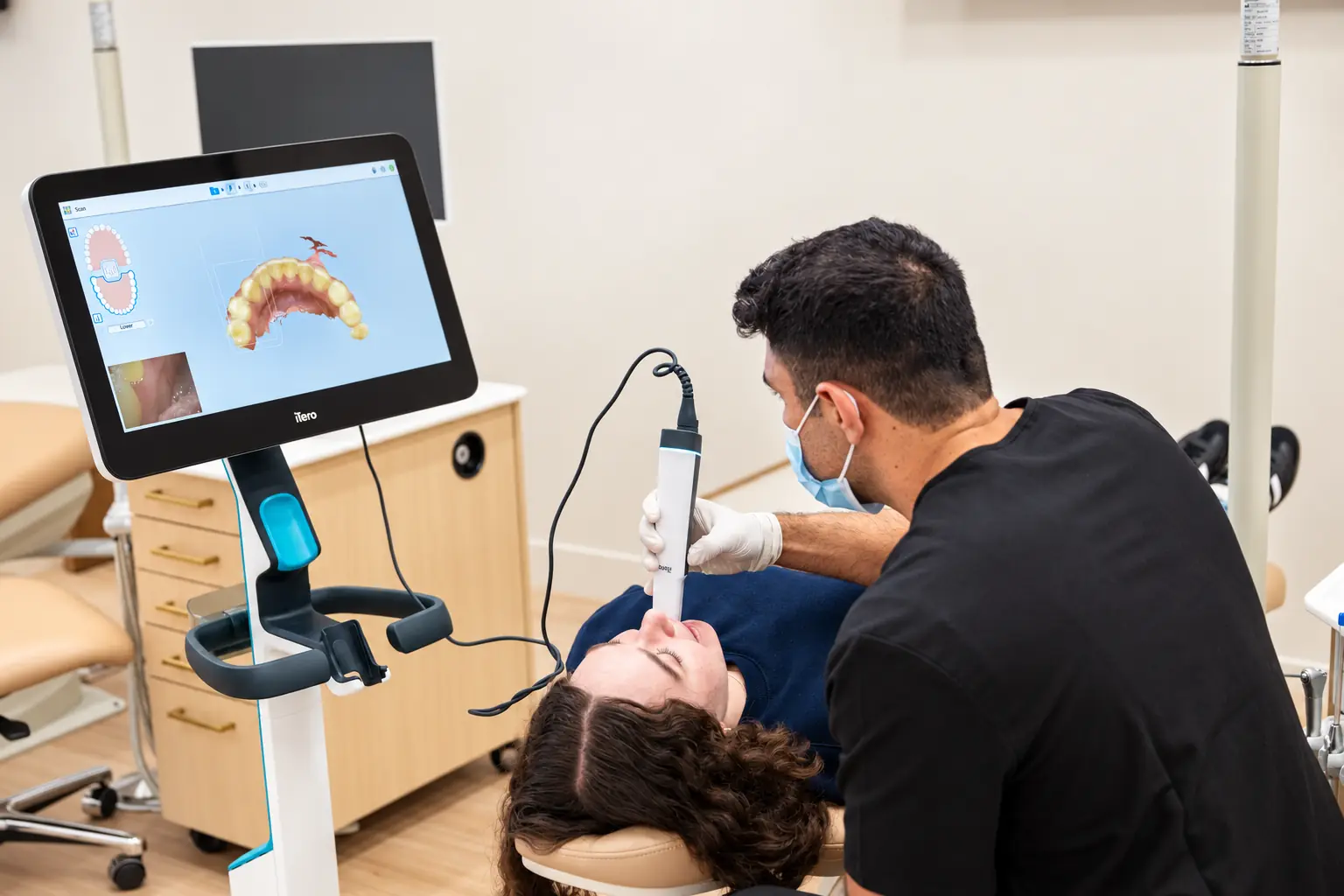
At our free consultation, the exam, any X-rays it needs and a digital scan of the teeth show whether space has to be made and whether braces or aligners suit the move. You can review the recommendation, timing and fee before deciding.
How do you fix a snaggle tooth?
By moving it. Standard braces or clear aligners can be used, depending on what the teeth need, and the plan starts with making room: the tooth cannot move into a space that is not there.
- Making space. Where crowding is severe, the NHANES III authors note that widening the arch or removing some teeth may be needed.
- Moving the tooth. Braces or aligners then guide the snaggle tooth into the line. Our guide to rotated teeth covers a tooth that is turned.
- Keeping it there. After braces come off, a retainer stops the teeth moving back, and the orthodontist tells you how long to wear it.
Veneers or bonding can change the shape and color of a tooth, but they do not move it. Our comparison of braces and veneers explains when each one fits. Our guide to DIY and basement braces explains the risks of moving teeth at home without an orthodontist.
When should a child’s snaggle tooth be checked?
The American Association of Orthodontists recommends that every child has an orthodontic check at the first sign of a problem and no later than age 7. An early check can show whether there is room for the canines that are still to come, and whether a baby tooth is staying too long.
An early check does not always mean early treatment. The same review notes that some children need early treatment and others do better with treatment in the teen years without it. More on growing smiles is in our practice notes.
Frequently asked questions
Can adults fix a snaggle tooth?
Yes. Most people who get orthodontic care are children, but adults get braces too, as MedlinePlus notes. The same appliances, braces or clear aligners, are used to move a snaggle tooth in an adult, after the same exam and records.
Can clear aligners fix a snaggle tooth?
They can be. Braces or clear aligners are used depending on what the teeth need, so which one fits depends on how the tooth has to move. An orthodontist can tell you after an exam and records.
How long does it take to straighten a snaggle tooth?
It depends on how far the tooth has to move and whether space has to be made first. For orthodontic treatment in general, one review gives an average of about 2 years, and an orthodontist can give you an estimate for your own teeth after an exam.
Will a snaggle tooth come back after braces?
It can if the teeth are not held in place. After braces come off, a retainer stops the teeth moving back to where they were, so wearing it as the orthodontist directs is what keeps the result.
More notes