
Tongue scraping: what it does and how to do it
What a tongue scraper does, what trials found for breath, coating and taste, how to use one gently, and what changes with braces or aligners.
By Dr. Shadi Haykani, DDSNovember 22, 20265 min read
Medically reviewed by Dr. Shadi Haykani, DDSLast reviewed November 22, 2026
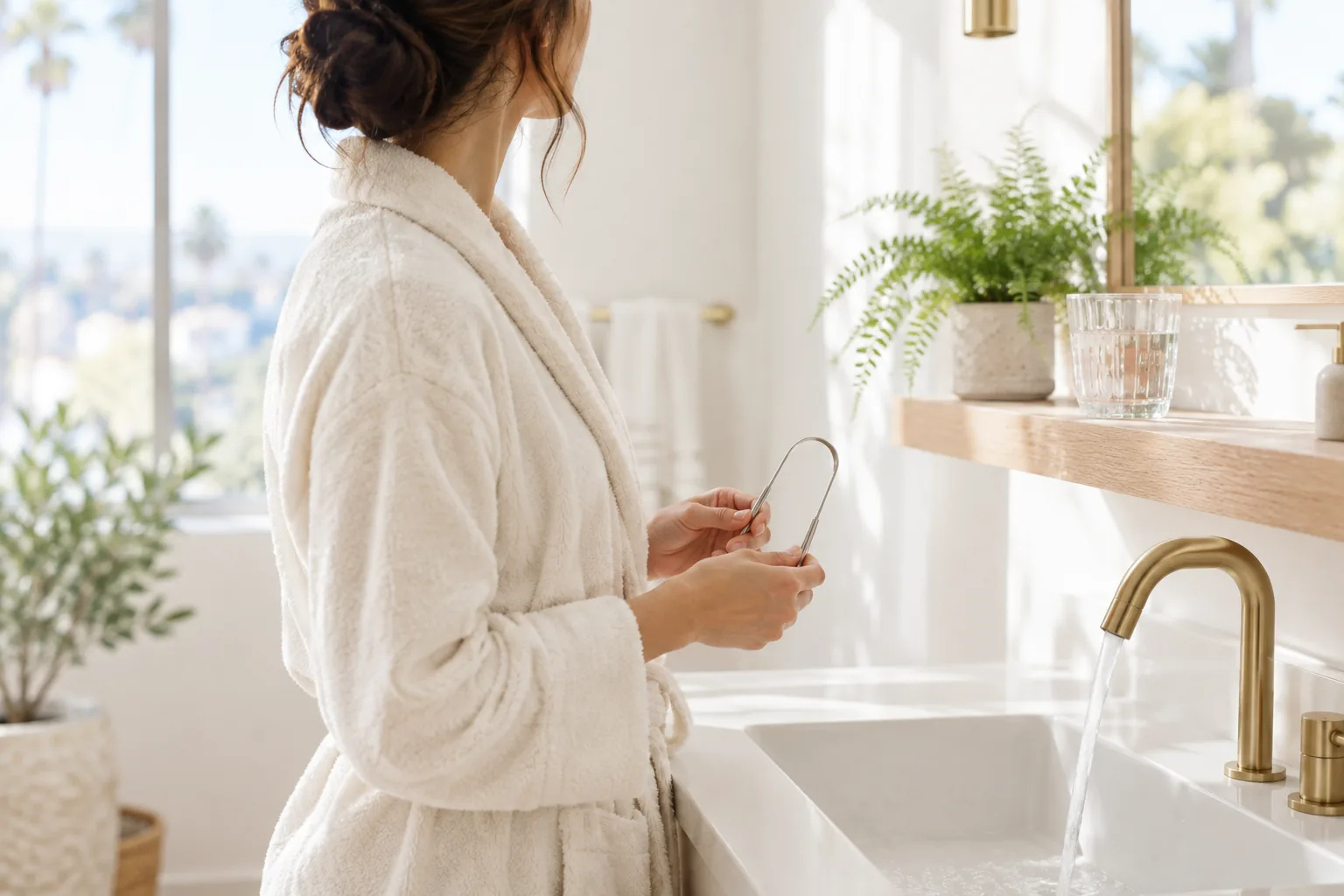
Tongue scraping removes the coating that builds up on the top of the tongue, and in studies it reduced that coating and measures of bad breath. A 2010 systematic review found that scraping or brushing the tongue, on top of toothbrushing, has the potential to reduce breath odor and tongue coating, but data on long-lasting bad breath were insufficient. A 2019 Cochrane review rated the evidence for tongue cleaning as very uncertain. To try it, the NHS suggests cleaning your tongue gently once a day with a tongue scraper or cleaner, and never so hard that it bleeds.
- A tongue scraper lifts off the coating of shed cells, food debris and microbes that collects on top of the tongue.
- Reviews found that tongue cleaning can reduce breath odor and tongue coating, though the evidence is weak and long-term effects are unclear.
- In a small study, two weeks of tongue cleaning improved taste and reduced the coating, while bacteria on the tongue barely changed.
- Clean your tongue gently once a day with a scraper or a toothbrush, never hard enough to make it bleed.
What does a tongue scraper do?
It scrapes away the coating on the top of the tongue. A 2025 review of tongue coating describes that coating as a biofilm, a layer of shed surface cells, food debris and microorganisms, and notes that it is common. Age, diet, smoking and general health conditions all affect how it forms, and the review links the coating closely with bad breath and gum disease.
A scraper is a thin strip, often bent into a U shape, that you draw across the tongue to lift the coating off. A toothbrush can do the same job, and studies have tested both.
What it removes is mostly the coating itself. In a 2004 study of 16 people, two weeks of scraping or brushing the tongue twice a day reduced the amount of coating significantly but lowered the bacteria on the tongue only negligibly. The authors concluded that tongue cleaning seems to reduce the material that bacteria break down into odors, rather than the number of bacteria.
What are the benefits of tongue scraping?
Less coating on the tongue is the most consistent finding, with some evidence for fresher breath and better taste. These are the main results:
| What was measured | What the studies found |
|---|---|
| Breath odor | A 2010 review of seven experiments found a positive effect of tongue cleaning, on top of toothbrushing, on measures of bad breath |
| Tongue coating | Coating went down with a scraper and with a toothbrush in the 2004 and 2018 studies |
| Taste | Taste improved after two weeks in the 2004 study, most with the scraper; people with gum disease noticed no change in 2018 |
| Bacteria | Two weeks of tongue cleaning made little or no difference to bacteria on the tongue or in saliva |
The 2010 review drew on five publications. The 2004 study found significant improvements in tasting bitter and salty test solutions after two weeks, especially with the scraper.
Results in people with gum disease were more modest. In a 2018 study of 18 adults with periodontitis, a serious gum infection, two weeks of tongue cleaning reduced the coating, and people felt their tongue was cleaner. They noticed no difference in their breath or their sense of taste, and the bacteria on the tongue and in saliva did not change.
Do tongue scrapers work?
For tongue coating, yes, in the studies above. For bad breath the evidence is weaker.
The 2019 Cochrane review looked at 44 trials of treatments for bad breath. For tongue cleaning against no tongue cleaning, it found only 2 trials with 46 people, and it rated the evidence as very low certainty. The review found low or very low certainty evidence for every bad-breath treatment it studied, so it could not say whether any one works better than another. Most of its trials followed people for a short time.
The 2010 review also found too little data on chronic bad breath, also called halitosis. When breath stays bad for weeks, the cause may be something a scraper cannot reach. The NHS lists gum disease, holes in your teeth and infections among the causes in the mouth, and it advises seeing a dentist about bad breath that does not go away after a few weeks of cleaning at home.
Should you brush your tongue?
Cleaning your tongue in some way belongs in a daily routine. NIDCR’s brushing tips include brushing your tongue, and the NHS advice for bad breath includes cleaning it once a day with a scraper or cleaner.
Both tools reduced tongue coating in the studies, and the 2018 study found no differences between a scraper and a toothbrush.
White patches are a different matter from the everyday coating. The NHS advises seeing a dentist or doctor if you have white patches on your tongue, or tongue pain or itchiness that does not go away or gets worse. A white tongue can be a sign of a health condition, it adds, such as oral thrush, lichen planus or leukoplakia, so have patches checked rather than trying to scrape them away.
How do you use a tongue scraper?
Gently, with a few strokes over the top of the tongue. In the 2004 study, people made two strokes with the scraper along the middle of the tongue and along its sides. A simple routine looks like this:
- Stand at a mirror and stick out your tongue.
- Draw the scraper gently along the middle of the top of your tongue.
- Repeat along each side of the tongue.
- Rinse the scraper and your mouth when you finish.
Once a day is the NHS suggestion; in the 2004 study, people cleaned their tongue twice a day for two weeks. Keep the pressure light. The NHS advises not to brush so hard that your gums or tongue bleed. A toothbrush works the same way if you prefer it: brush over the top of the tongue with soft strokes.
Do you need to scrape your tongue with braces or aligners?
Braces and aligners do not change how you clean your tongue. Our guide to bad breath with braces includes gently cleaning your tongue once a day alongside brushing twice a day and cleaning between the teeth, because food and plaque left around brackets and wires can add to the smell. Our guide to brushing teeth with braces shows how to clean the gumline, above and below each bracket, and every tooth surface.
If you wear aligners or a removable retainer, the appliance needs cleaning too. Our guide to cleaning retainers says to clean a removable retainer daily with a soft brush and cool or lukewarm water. More everyday care topics are in our dental health notes.
Frequently asked questions
Should you use a tongue scraper before or after brushing?
The studies here did not test the order, so there is no evidence that one order works better than the other. The 2010 review looked at tongue cleaning done in addition to toothbrushing, so what was tested is cleaning the tongue as part of the same routine. Pick the order you will stick with, and rinse your mouth when you are done.
Are tongue scrapers safe?
Used gently, a scraper is part of the routine the NHS suggests for bad breath, which also warns against brushing so hard that your gums or tongue bleed. The trials have little to say about harms: the 2019 Cochrane review found no data on side effects for tongue cleaning. Scrape lightly and stop if it hurts. The NHS advises seeing a dentist or doctor about tongue pain that does not go away or gets worse.
Can tongue scraping damage your taste buds?
The two small studies that tested taste found no loss of it. In the 2004 study, two weeks of tongue cleaning improved people’s sense of taste, especially with the scraper, and in the 2018 study people with gum disease noticed no change in taste either way. Light pressure is the safeguard: scrape gently and stop short of making the tongue bleed.
Is a copper or metal tongue scraper better than a plastic one?
No study in our sources compared materials. The 2004 study used a plastic scraper, and in the 2018 study a scraper and a toothbrush gave the same results. Choose a tool that is comfortable to use and easy to rinse clean, and use it gently.
More notes