
Interdental brushes: what they are and how to use them
What interdental brushes are, how they compare with floss, how to choose a size and use one, and how they fit around braces and retainers.
By Dr. Shadi Haykani, DDSNovember 23, 20266 min read
Medically reviewed by Dr. Shadi Haykani, DDSLast reviewed November 23, 2026
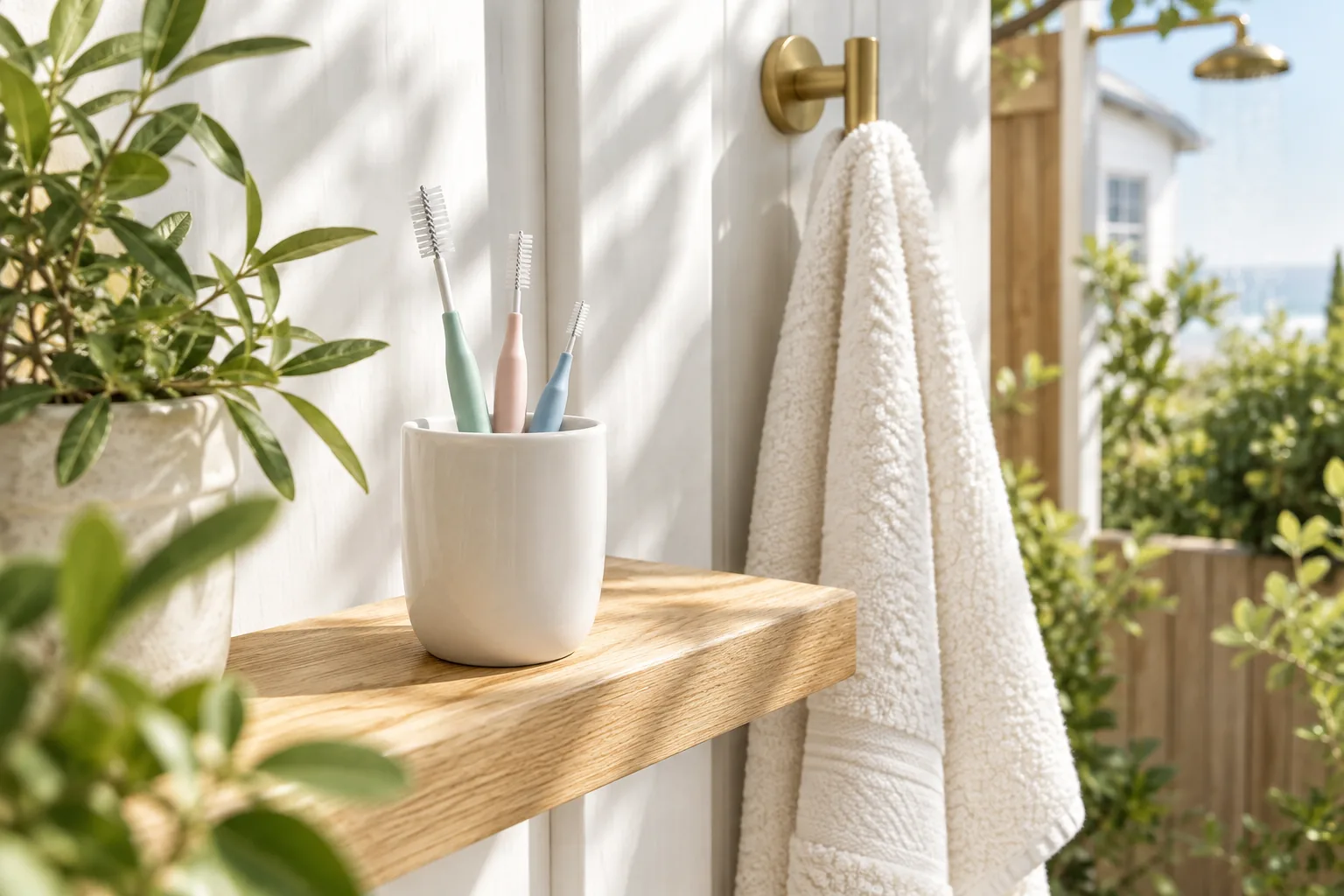
An interdental brush is a small brush specially designed to clean between teeth, in the spaces where brushing can’t reach. In a 2019 Cochrane review of 35 trials, interdental brushes used along with toothbrushing may have reduced gum inflammation more than floss, although the certainty of that evidence was low. The brush should fit each space snugly without being forced, so ask your dentist or hygienist to check the sizes you need. Clean between your teeth once a day, and with braces, use the brush between the teeth and under the wire.
- Choose a brush that fits each space snugly without forcing it, and clean between your teeth once a day.
- In a 2019 Cochrane review, interdental brushes may have reduced gum inflammation more than floss, although the evidence was low certainty.
- Interdental brushes are small brushes made to clean the spaces between teeth that a toothbrush misses.
- With braces, an interdental brush can clean between the teeth and under the wire every day.
What is an interdental brush?
It is a small brush for the spaces between your teeth. The National Institute of Dental and Craniofacial Research (NIDCR) describes tiny interdental brushes as specially designed to clean between teeth, and a 2026 systematic review defines the interdental brush as an add-on oral hygiene tool designed to clean the spaces between teeth and remove dental plaque.
Those spaces matter because plaque, a sticky film of bacteria, builds up there. If plaque is not removed, some of it can harden below the gum line and irritate the gums, which become red, swollen and may bleed easily: the signs of gingivitis, a mild form of gum disease. Hardened plaque, called tartar, can be removed only by a dentist or dental hygienist.
NIDCR lists an interdental (between-the-teeth) brush alongside floss, a wooden or plastic pick and a water flosser recommended by a dental professional. The NHS advises cleaning in between your teeth every day using floss or interdental brushes. More everyday questions about teeth and gums are in our dental health articles.
Are interdental brushes better than floss?
They may be, for gum inflammation, though the evidence is weak. The 2019 Cochrane review of 35 trials with 3,929 adults found low-certainty evidence that interdental brushes may reduce gingivitis more than floss at one and three months. It found no difference for deeper gum disease measured by pocket depth, and the results for plaque were inconsistent.
Compared with toothbrushing alone, adding an interdental brush may reduce plaque (low-certainty evidence) and gingivitis at one month (very low-certainty evidence). The authors noted that most trials were short, most participants had little gum inflammation to begin with, and the effects seen may not be clinically important.
Expert panels lean toward brushes. A 2015 working group on preventing gum disease called interdental brushes the device of choice for cleaning between teeth, and it limited floss to healthy sites where a brush will not pass through without trauma. A 2026 expert round table concluded that, in general, interdental brushes are the preferred option.
How do you choose the right interdental brush size?
Match the brush to the space. The NHS says the brush should fit snugly between the teeth. In a 2021 study of sizing methods, one experienced clinician and five dental students sized 204 spaces in 34 patients with periodontitis, a more severe gum disease, both by trying brushes one after another and with a color-coded measuring tip. The authors concluded that the measuring tip may be an alternative to trying brushes one by one for moderate to wide spaces.
Sizes are not standardized from brand to brand. A 2020 study of 2,320 brushes from 24 manufacturers found sizes from 0.6 to 5.2 mm, measured by the width of the hole a brush can pass through, with 90% at 2.0 mm or less. The steps between sizes were unsystematic, and only 33% of manufacturers gave the standard ISO size on their products. If you change brands, ask your dental team to check the fit again.
Shape matters as well. In a 2014 trial of 128 adults, straight brushes removed more plaque between back teeth than angled ones, with no difference in damage to the gums. A 2024 review suggested that waist-shaped brushes, narrower in the middle, could clean wide spaces better than straight or cylindrical ones, although it could not pool the results of its three trials.
How do you use an interdental brush?
Have your dentist or hygienist show you first, since they can advise you on how to clean between your teeth. Then:
- Use the size chosen for each space, one that fits snugly.
- Ease the brush gently into the space. It should not need force, and a brush that will not go in is too big for that space.
- Work through every space you can reach. Where your dental team suggests it, clean from the tongue side as well: a 2021 review noted that plaque can remain on the tongue side of a space, so going in from that side is sometimes needed.
- Do it once a day. NIDCR advises cleaning between teeth regularly, aiming for once a day, along with brushing twice a day with fluoride toothpaste.
- Go easy on toothpaste. In a 2024 laboratory study, an interdental brush used with toothpaste wore away samples of dentin, the hard yellow part under the enamel, while gels and solutions caused no measurable loss. The authors warn against overuse, especially with abrasive toothpaste, so ask your dentist whether to use anything on the brush.
Can you use an interdental brush with braces?
Yes. The NHS advises using an interdental brush to clean between your teeth and underneath your braces every day, along with brushing with fluoride toothpaste in the morning, at night and after meals.
A 2026 systematic review of six trials with 442 orthodontic patients found low-certainty evidence that interdental brushes may reduce plaque and gum inflammation compared with toothbrushing alone or floss, with greater benefit when used with an orthodontic toothbrush. Interdental brushes showed no consistent advantage over single-tufted brushes or water flossers, follow-up was generally short, and few trials reported on safety.
A small interdental brush can help with the accessible areas around brackets and wires, and our guide to brushing with braces covers the rest of the routine. We can show you how to use floss threaders or interdental brushes in difficult areas.
After braces, a bonded (fixed) retainer needs cleaning between the teeth and beneath the wire each day, without tugging on the wire. Our guide to permanent retainers explains that routine, and we can show you a floss threader or a suitable interdental brush if access is difficult.
When might floss or a water flosser suit you better?
When the spaces are tight, or a brush is hard to handle. A 2021 review of 27 studies that built a decision tree for cleaning between teeth named floss the first choice for people with tight, closed spaces who are motivated and good with their hands. For open spaces, it found the most evidence for an interdental brush.
Comfort and dexterity count too. The 2026 round table said that individual preferences and dexterity should be considered: non-wired cleaners may suit beginners, and an oral irrigator, the device type that includes water flossers, may suit people with limited dexterity, such as older adults.
In a 2025 trial in 78 young adults with moderate gum inflammation, the water flosser group had lower gum bleeding scores than the interdental brush group after four weeks, with no difference in gum abrasion. Our guide to water flossers for braces compares the options with an appliance, and our guide to black triangles after braces explains the open spaces some people notice near the gums once braces come off.
Frequently asked questions
Are interdental brushes reusable?
They can be used more than once, though repeated bending can break them. In a 2004 laboratory test of brushes from five makers, the thin wire stems broke after repeated bending, and angled, L-shaped brushes broke sooner than straight ones. Ask your dentist or hygienist how long to keep using one, and stop using a brush whose wire has bent out of shape or broken.
What if an interdental brush won’t fit between your teeth?
Do not force it. In a 2020 study of brushes from 24 makers, the smallest size was 0.6 mm, so a smaller size may fit. For a healthy space too tight for any brush, a 2015 working group recommends floss, and a 2021 review lists easy flossers, soft picks, water flossers and small brushes of 0.6 to 0.7 mm as alternatives for tight spaces when floss is hard to use. Your dentist or hygienist can check which tool suits each space.
Can interdental brushes damage gums?
Studies that looked for harm have found little sign of it. The 2019 Cochrane review found no severe events caused by cleaning devices and no difference between groups in minor effects such as gum irritation. A 2020 laboratory study judged the force needed to insert brushes mostly moderate and unlikely to injure the gums and the tissues that support the teeth. Use a size that fits snugly without force, and tell your dentist if cleaning a space hurts.
Can I use interdental brushes instead of flossing?
Yes, for the spaces a brush fits. The NHS says you can use interdental brushes or single-tufted brushes instead of flossing, especially if there are gaps between your teeth. NIDCR lists both floss and interdental brushes among the ways to clean between teeth. A very tight space may still need floss, so ask your dentist or hygienist which tool suits each part of your mouth.
More notes