
How often should you change your toothbrush?
The 3-month advice and where it comes from, what studies of old and worn brushes found, the signs of wear to look for, and electric brush heads.
By Dr. Shadi Haykani, DDSNovember 22, 20265 min read
Medically reviewed by Dr. Shadi Haykani, DDSLast reviewed November 22, 2026
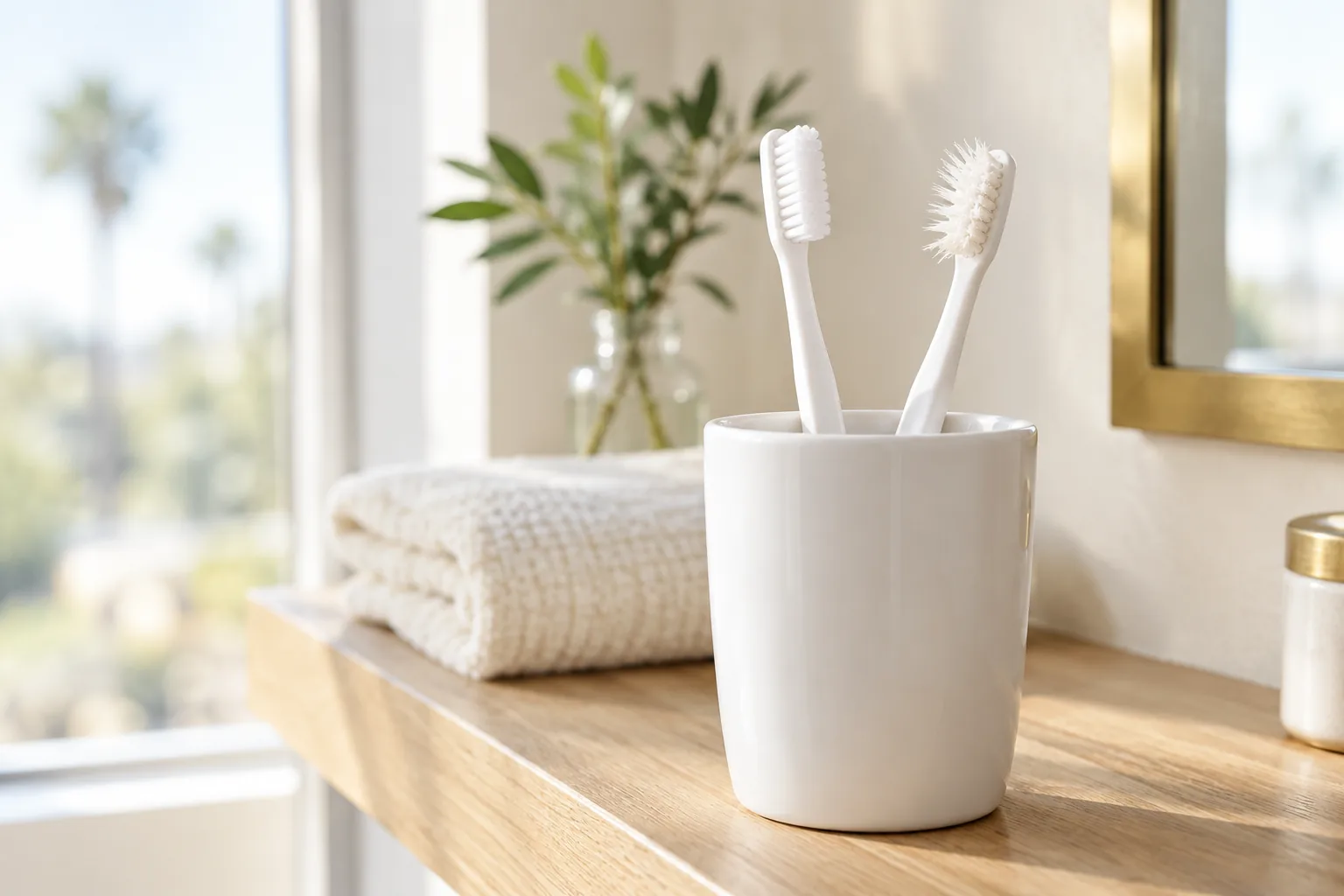
Change your toothbrush when the bristles become worn: that is how NIDCR puts it, with no fixed number of months. The figure most people hear is every 3 months, and researchers note that manual brushes are often recommended to be replaced on that schedule. Studies disagree on whether a 3-month-old brush cleans worse, and the bristles appear to be a better guide than the calendar. In a 2019 study of 172 people, brushes with extreme wear left more plaque, and the authors named outer tufts splaying beyond the base of the brush as the sign that it is time for a new one. Electric brush heads wear out too.
- A toothbrush is due for replacement once its bristles look worn, whatever the date on the calendar.
- The usual advice is every 3 months, and studies found 3-month-old brushes cleaned as well as new ones in some groups and worse in others.
- Outer tufts that splay beyond the base of the brush are the sign to watch for, and extremely worn brushes left more plaque.
- Electric brush heads wear too, and heads with the most extreme wear removed less plaque than new ones in a 2003 study.
How often should you replace your toothbrush?
Replace it when the bristles become worn. NIDCR’s brushing tips give that rule and no fixed number of months.
The 3-month rule is the number most people hear. Researchers in a 2002 trial started from the point that manual toothbrushes are often recommended to be replaced every 3 months. Dentists themselves vary: in a survey of 3,406 Australian dentists, 56.6% thought the average adult should renew a toothbrush every two to three months, 23.8% said one month or sooner, and 11.5% said six months or longer.
No interval has been settled by research. A 2024 review of recent trials concluded that more studies are needed to clarify how long a manual toothbrush should be used before it is replaced.
Does an old toothbrush clean worse?
Sometimes. In two studies published in 2003, one with a manual brush and one with a powered brush, people brushed twice a day for three months before their worn brush was tested against a new one. Both brushes reduced plaque. The new manual brush did better on the surfaces between the teeth, and the authors concluded that a worn toothbrush removes plaque less efficiently than a new one.
Other trials found no difference. In the 2002 trial with 40 adults, 3-month-old brushes removed plaque as well as new ones, even when their wear was marked. A trial in 93 children aged 7 to 9 reached the same result with their 3-month-old manual brushes.
The amount of wear seems to explain the split better than the age of the brush. The 2019 study collected the brushes of 172 people every 3 months. Wear varied widely from person to person, and people whose brushes showed extreme wear had higher plaque scores than people whose brushes showed no visible or light wear. The authors concluded that splayed bristles appear to be a better measure of when to replace a brush than how old it is.
When should you replace your toothbrush?
Replace it once the outer tufts splay. The 2019 study names outer tufts spreading beyond the base of the brush as the condition that means it is time for a new one, and bending and splaying of the bristles was also the sign that 70% of dentists named in the Australian survey.
Check the brush in good light now and then:
- Look at the head from the side. Bristles that lean outward past the edge of the plastic base have splayed.
- Look at it from the end. Tufts that bend or fan apart are worn.
- Notice how long your last brush lasted. In the 2019 study, the wear on each person’s brushes was fairly consistent from one brush to the next, so your own pattern is a useful guide.
A brush can splay well before 3 months or still look fine after it, so the check matters more than the date you bought it. Many people keep a brush too long, in the view of the dentists surveyed: 85.7% felt that patients should renew their toothbrushes more often.
How often should you change an electric toothbrush head?
Use the same bristle check. In the 2003 powered-brush study, new brush heads showed a tendency to remove more plaque than heads used for three months, though the difference was not statistically significant across the whole group.
The gap was clear for the heads that had worn the most. Among the 15 people whose brush heads had the most extreme wear, new heads removed significantly more plaque, both across the whole mouth and on the surfaces between the teeth. Replace the head when its outer tufts splay, and follow your brush’s instructions for anything that depends on the model.
Do toothbrushes collect germs over time?
Yes. A 2024 review of 15 studies found that a toothbrush becomes contaminated after its first use and that the contamination rises the longer it is used. Humidity from a plastic cover or a toilet setting was among the factors that added to it.
The review’s findings are about germs on the brushes, and it reports no results on illness, so it does not show that a new brush prevents getting sick.
Why do worn bristles matter more with braces?
Braces make brushing harder. A 2009 review notes that orthodontic appliances restrict toothbrush access, so people in treatment need special oral care and advice.
Plaque left around brackets is where white spots can start. Bacteria in plaque use sugar to make acids that pull minerals out of the enamel, and when this happens often, a white spot may appear where minerals have been lost, NIDCR explains. It is a sign of early decay, and at that stage the decay can still be stopped or reversed.
Our guide to brushing teeth with braces shows how to clean around each bracket and wire, and it also says to replace a brush when the bristles become frayed or worn. If a pale patch shows up near a bracket, our notes on white spots around braces explain what to do next.
A removable retainer gets brushed too. Our guide to cleaning retainers says to clean one daily with a soft brush and cool or lukewarm water, so the same check for worn bristles applies to that brush. More everyday care topics are in our dental health notes.
Frequently asked questions
How long do toothbrushes last?
There is no fixed lifespan. In a 2019 study of 172 people, the wear on 3-month-old manual brushes varied widely from one person to the next, while each person’s own brushes wore at a fairly consistent rate. A brush lasts until its outer tufts splay beyond its base, and the time your last brush took to reach that point is a reasonable guide to the next one.
How long do electric toothbrushes last?
Research on electric brushes looks at the brush head, which is the part that wears. In a 2003 study of a powered brush, heads with the most extreme wear after three months removed significantly less plaque than new heads. Check an electric head the same way as a manual brush and replace it when the outer tufts splay. For the handle, follow the maker’s instructions.
Should you replace your toothbrush after being sick?
The research does not answer this directly. A 2024 review found that toothbrushes become contaminated from the first use, but it reports no results on illness, so it does not show that a new brush keeps you from getting sick again. A brush with worn, splayed bristles is due for a new one either way.
Do children need to replace their toothbrush as often?
The same bristle check works for children. A trial in 93 children aged 7 to 9 found that their 3-month-old manual brushes removed plaque as well as new ones, whatever their degree of wear. Children’s brushes can still splay, and NIDCR’s rule of replacing a toothbrush when the bristles become worn is the one to follow.
More notes